

In the commercial trucking industry, prospecting has never been simple. Fleets vary widely in size, equipment mix, operating geography, and buying behavior. And yet many sales and marketing teams are still forced to rely on broad lists, outdated assumptions, or manual research to decide who to contact.
The result is familiar: too much time spent chasing the wrong prospects, not enough time focused on real opportunities.
That’s the problem RigDig was built to solve.
RigDig gives manufacturers, dealers, and aftermarket providers the ability to move beyond surface-level targeting and into precision prospecting, using granular data tied directly to fleet equipment, operations, and activity.
The Problem: Why Broad Prospecting No Longer Works
What RigDig Is, and Who It’s Built For
RigDig is the most comprehensive source of equipment buyer data in the commercial trucking industry, covering more than 1.6 million fleet prospects across the United States. It is designed specifically for teams that need to understand who owns what equipment, where it operates, and how that fleet behaves in the market.
Manufacturers, dealers, and aftermarket providers rely on RigDig to analyze markets, uncover opportunities, and stay ahead of competitors—not through guesswork, but through structured, continuously refreshed data.
What sets RigDig apart is not just the breadth of its coverage, but the quality and structure of its data. RigDig aggregates multiple trusted sources, including:
- USDOT registration records
- FMCSA activity data (such as inspections and violations)
- UCC finance filings
- D&B firmographic data
This information is cleaned, standardized, and refreshed on a daily or monthly cadence depending on the source. Activity data typically becomes available within 60–90 days, giving users timely visibility into what’s happening across the fleet landscape.
Why Granular Search Matters More Than Ever
In today’s market, knowing that a company “owns trucks” is not enough.
Sales teams need to know:
- What type of equipment a fleet operates
- How old that equipment is
- Where it runs
- Whether the fleet is growing, stable, or under pressure
- How closely that fleet aligns with what they sell
This is where RigDig’s granular search capabilities fundamentally change the prospecting equation.
Instead of relying on broad categories, RigDig allows users to build searches using 25+ filters, combining equipment, operational, and geographic attributes to surface prospects that truly match their ideal customer profile.
What You Can Search for with RigDig
RigDig’s Search Tool is designed to help teams identify and qualify prospects with precision.
Users can filter and segment fleets by:
- Location and geography, including region, state, or proximity to a specific address
- Equipment brand and type, allowing users to focus on fleets already running the trucks they sell or support
- Vehicle age, helping identify fleets that may be approaching replacement cycles
- Fleet size and composition, from owner-operators to large multi-unit carriers
- Operational signals, such as inspection or violation activity
Searches can be saved, shared, exported, and assigned across teams, making RigDig as useful for strategic planning as it is for day-to-day prospecting.
Ready to Prospect with Precision?
The Application: How RigDig Turns Data into Equipment Turns
Turning Data into Faster Equipment Turns
To understand how this works in practice, consider the following realistic scenario.
The Situation
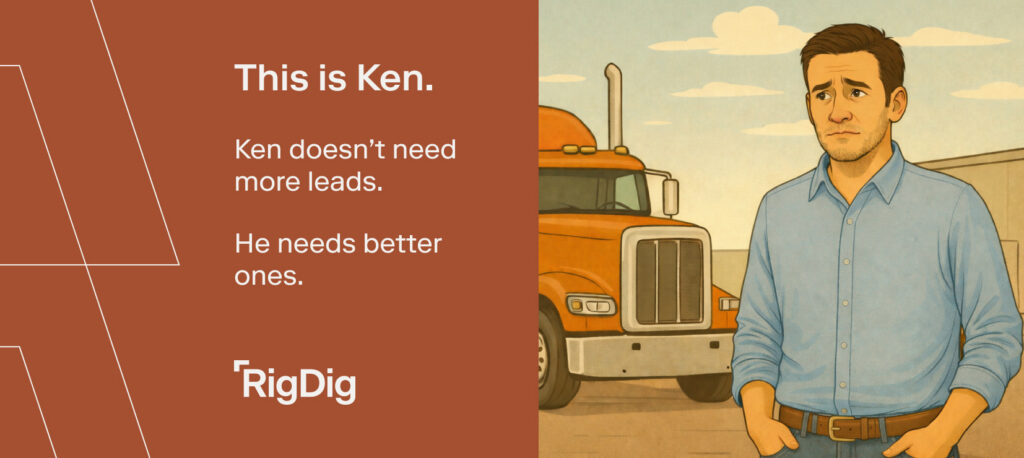
Ken is our fictional Used Truck Sales Manager at a regional dealership serving the Upper Midwest. His territory spans multiple states, and his lot inventory changes constantly.
This quarter, Ken has six late-model trucks he needs to move quickly. They’re solid units, competitively priced—but every week they sit adds pressure to margins.
Generic prospect lists haven’t helped. Too many calls go nowhere. Too much time is spent qualifying companies that were never a good fit.
Ken doesn’t need more leads. He needs better ones.
How Ken Uses RigDig
Ken starts with RigDig’s Search Tool.
- Define the territory
He limits his search to fleets operating within his area of responsibility. This immediately removes thousands of irrelevant prospects. - Filter by equipment
Next, Ken filters for fleets already operating the same make and model of truck he’s selling. This ensures familiarity and lowers friction in the conversation. - Refine by fleet age
He applies a fleet-age filter to focus on operators whose equipment is old enough to suggest replacement or expansion needs.
What begins as tens of thousands of potential companies becomes a focused list of just over 1,000 highly relevant prospects.These are fleets that operate similar equipment, within his territory, and with characteristics that align to his inventory.
The Result
Ken’s outreach changes immediately.
Calls no longer start with generic introductions. Instead, they’re grounded in real context:
- “We see you’re already running this model…”
- “Based on your fleet age, this might be a good fit…”
- “We work with several fleets operating in your corridor…”
Response rates improve. Conversations move faster. Inventory turns sooner.
The difference isn’t effort; it’s focus.

The Intelligence Layer: Prospect Profiles & Team Access
Prospect Profiles: From Names to Context
RigDig doesn’t stop at list creation.
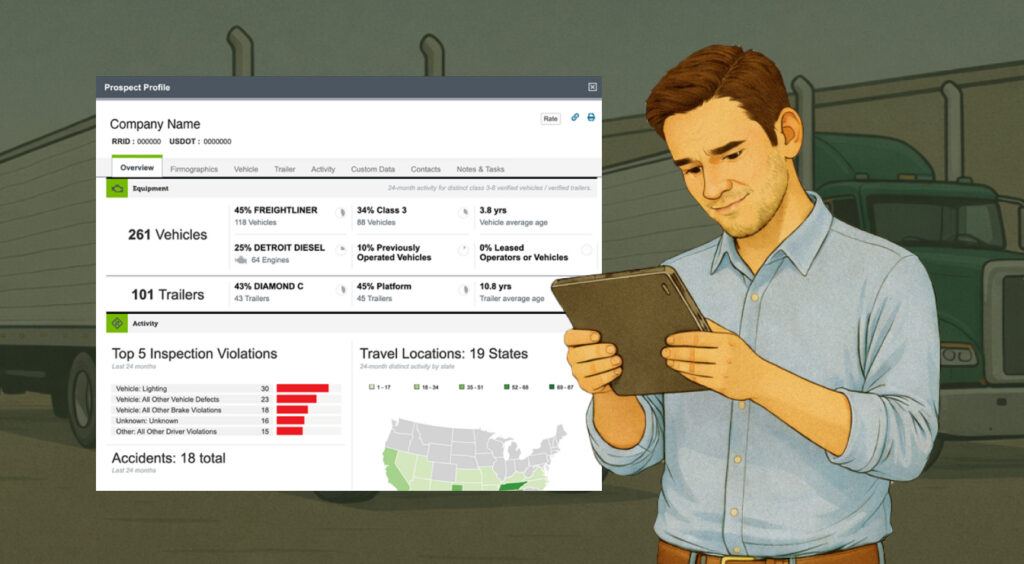
Each prospect includes a Prospect Profile that brings together the information sales teams need to qualify accounts and sharpen outreach. Profiles answer critical questions such as:
- What equipment does this fleet operate?
- How old is the fleet?
- Is the fleet more likely to buy new or used equipment?
- What operational activity may indicate opportunity?
This depth of insight helps sales reps prioritize outreach and tailor messaging before they ever pick up the phone.
For reps in the field, RigDig’s mobile access ensures the same intelligence is available on the road, supporting territory execution and real-time decision-making.
How Different Teams Use RigDig
RigDig’s value shows up differently depending on who’s using it. But the underlying benefit is the same: clarity.
Manufacturers
Manufacturers use RigDig to focus on active fleets already running the trucks they sell. This makes it easier to track shifts in market share, monitor competitive encroachment, and identify opportunities for service, maintenance, and parts programs tied to existing equipment in the field.
Dealers
Dealers rely on RigDig to target equipment owners within their defined territories, uncover regional growth trends, and provide sales teams with activity-based leads. Instead of chasing volume, reps can prioritize prospects that align with their inventory, territory, and timing.
Aftermarket Providers
Aftermarket companies use RigDig to pinpoint fleets aligned with their parts, software, or services. By understanding where equipment is operating and under what conditions, teams can target maintenance opportunities and expand revenue in key regions.
Across all audiences, RigDig replaces assumptions with evidence.
Ready to Prospect with Precision?
Stop working broad lists and start focusing on fleets that actually match your business. With RigDig, you can search by equipment, operations, and geography to uncover high-value opportunities hiding in plain sight.
How Teams Access RigDig
RigDig is available in multiple formats to support how teams work:
- A web platform for analysis, searching, and list building
- A data integration package that connects RigDig insights directly into CRM environments
- A mobile app for reps who need intelligence on the road
This flexibility ensures that data isn’t siloed. It’s accessible wherever decisions are being made.
The Strategic Context: Where RigDig Fits & Why It Matters Now
The Broader Context: Where Fusable Fits
RigDig operates within a broader ecosystem focused on improving how equipment intelligence is used across sales and marketing teams.
Fusable provides data and intelligence solutions designed to help organizations prospect smarter and make better decisions across equipment-intensive industries, including trucking, construction, and agriculture.
Fusable’s focus is on supporting a more consistent, data-driven approach to prospecting and planning, regardless of where that work takes place.
Recently, Fusable introduced a Salesforce App and API designed to help sales and marketing teams bring equipment and company intelligence closer to their everyday workflows. These tools aim to reduce manual research, improve data consistency, and support more informed outreach and pipeline planning—without requiring teams to abandon the systems they already use, including Salesforce.
RigDig and Fusable address different, but complementary, needs. RigDig delivers deep, granular insight into fleet composition and behavior, while Fusable focuses on helping teams work more efficiently with equipment intelligence across their sales and marketing environments. Together, they reflect a shared belief: better data leads to better decisions.
Why This Matters Now
Markets are more competitive. Buyers are more informed. Sales cycles are under scrutiny.
In this environment, success depends less on how many prospects you contact, and more on how accurately you target them.
RigDig’s granular search capabilities help teams:
- Reduce wasted outreach
- Prioritize high-probability accounts
- Align sales and marketing around the same source of truth
- Enter conversations with context, not assumptions
Precision prospecting is no longer a nice-to-have. It’s the foundation for sustainable growth.
Turning Data into Advantage
RigDig isn’t about more data. It’s about better focus.
By allowing teams to search by equipment, operations, and hyper-local geography, RigDig helps organizations move beyond broad lists and into targeted action. It enables sales teams to spend time where it matters most, and to approach every conversation informed and prepared.
In an industry where timing and relevance matter, knowing exactly who you’re talking to before you reach out is a serious competitive advantage.
RigDig makes that possible.
Ready to Prospect with Precision?
Stop working broad lists and start focusing on fleets that actually match your business. With RigDig, you can search by equipment, operations, and geography to uncover high-value opportunities hiding in plain sight.